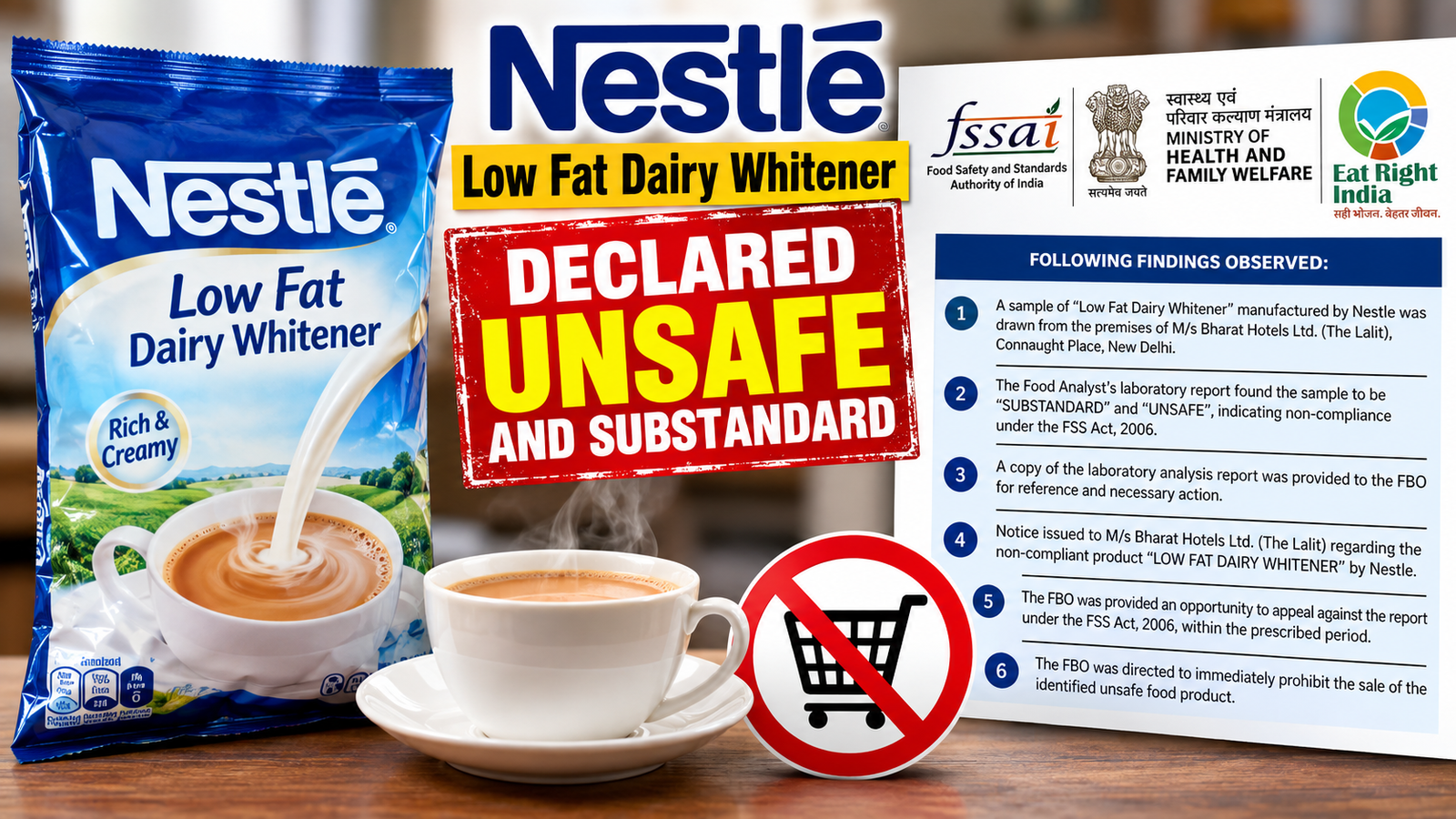
A food-safety concern has emerged after a sample of Nestle Low Fat Dairy Whitener was reportedly declared “unsafe” and “substandard” following laboratory analysis by a Food Analyst. The sample was collected from the premises of M/s Bharat Hotels Ltd. (The Lalit) located at Connaught Place, New Delhi.
According to the food safety notice, the laboratory report identified non compliance under the Food Safety and Standards Act, 2006. Following the findings, a notice was issued to the concerned Food Business Operator (FBO), and directions were given to immediately prohibit the sale of the identified food product.
The development highlights the importance of food testing, regulatory compliance, and consumer awareness in India's packaged food industry.
The notice further states that the concerned FBO was provided with a copy of the laboratory analysis report and an opportunity to appeal against the Food Analyst's findings within the prescribed period under the applicable provisions of the law.
What Happened in the Nestle Low Fat Dairy Whitener Case?
According to the notice, a sample of Nestle Low Fat Dairy Whitener was collected from M/s Bharat Hotels Ltd. (The Lalit), Connaught Place, New Delhi.
The collected sample was subsequently examined by a Food Analyst. The laboratory report reportedly classified the product sample as both “substandard” and “unsafe.”
These classifications indicate that the sample was found to be non-compliant with applicable food-safety requirements under the Food Safety and Standards Act, 2006.
Following the laboratory findings, the concerned Food Business Operator was informed about the report and provided an opportunity to take the matter forward through the prescribed appeal procedure.
The notice also directs the immediate prohibition of the sale of the identified unsafe food product.
It is important to understand that the reported action concerns the specific product sample identified in the notice. It should not automatically be interpreted as a declaration that all Nestle products or every batch of Low Fat Dairy Whitener available in the Indian market is unsafe.
Key Findings Mentioned in the Food Safety Notice
The notice highlights several important developments in the case.
1. Sample Collection from The Lalit, New Delhi
A sample of Nestle Low Fat Dairy Whitener was collected from the premises of M/s Bharat Hotels Ltd. (The Lalit), located in Connaught Place, New Delhi.
Sample collection is an important part of food-safety monitoring, allowing authorities to examine food products for compliance with applicable standards.
2. Laboratory Report Identified the Sample as Unsafe and Substandard
The Food Analyst's laboratory report reportedly found the sampled Low Fat Dairy Whitener to be “unsafe” and “substandard.”
These findings indicated non compliance under the Food Safety and Standards Act, 2006.
However, the supplied notice does not specify the exact laboratory parameters, chemical findings, contaminant levels, or technical reasons behind the classification. Therefore, no particular contaminant or health effect should be assumed without access to the complete laboratory report.
3. Laboratory Report Provided to the Food Business Operator
According to the notice, a copy of the laboratory analysis report was provided to the concerned Food Business Operator for reference and necessary action.
This is an important procedural step because it informs the concerned business about the findings and the basis of the regulatory action.
4. Notice Issued to Bharat Hotels Ltd.
A notice was issued to M/s Bharat Hotels Ltd. (The Lalit) concerning the non compliant product.
The notice forms part of the regulatory response to the laboratory findings.
5. Opportunity to Appeal
The Food Business Operator was provided an opportunity to appeal against the Food Analyst's report within the prescribed period under the applicable provisions of the FSS Act, 2006.
This is significant because food safety enforcement involves legal procedures, including opportunities for the concerned party to challenge laboratory findings through the prescribed process.
6. Immediate Prohibition of Sale
The notice states that the FBO was directed to immediately prohibit the sale of the identified unsafe food product.
This is the most important consumer-facing direction mentioned in the supplied notice.
What Does “Unsafe Food” Mean Under the Food Safety and Standards Act?
The Food Safety and Standards Act, 2006, provides the legal framework for regulating food safety and standards in India.
The Act establishes requirements concerning food quality, safety, manufacturing, storage, distribution, sale, and other activities associated with food businesses.
Under this framework, food products are subject to regulatory assessment to determine whether they meet applicable safety requirements.
A product identified as unsafe raises concerns beyond ordinary quality defects. The classification relates to food-safety compliance and requires appropriate regulatory attention.
However, the exact basis for an unsafe classification depends on the findings of the relevant analysis and the applicable legal provisions.
In the present case, the supplied notice identifies the sample as unsafe and substandard but does not disclose the detailed laboratory parameters.
Consumers should therefore avoid concluding the specific cause of the finding until the complete laboratory report or official regulatory clarification becomes available.
What Does “Substandard Food” Mean?
The term “substandard” generally relates to a food product that does not meet the prescribed standards or specifications applicable to that category of food.
Food standards may cover several characteristics, including:
Composition and ingredient requirements.
Nutritional or physical specifications.
Permitted limits for specified substances.
Product identity and quality requirements.
Applicable food-safety regulations.
A substandard finding is not necessarily identical to an unsafe finding. The two classifications have different regulatory meanings, although both may indicate non compliance.
In the Nestle Low Fat Dairy Whitener case, the notice reports both classifications for the tested sample.
The distinction matters because consumers should understand that food quality and food safety are related but not interchangeable concepts.
Why Is Food Testing Important for Packaged Dairy Products?
Dairy products and dairy based preparations are widely used in households, hotels, restaurants, cafes, bakeries, and institutional kitchens.
Dairy whiteners are commonly used in beverages and food preparations where a creamy appearance or milk-like consistency is desired.
Because such products may be used in commercial food preparation, maintaining consistent quality and regulatory compliance is important.
Food testing helps authorities assess whether products comply with applicable requirements.
It can also help identify potential problems that may not be visible through ordinary inspection.
For consumers, this highlights an important principle: the appearance, smell, taste, or brand reputation of a food product alone cannot establish whether it complies with all regulatory standards.
Laboratory testing and regulatory oversight play an essential role in food-safety monitoring.
What Should Consumers Know About the Nestle Dairy Whitener Notice?
The reported finding may raise questions among consumers about the safety of packaged dairy products.
However, the available notice identifies a particular sample collected from a specific location.
Consumers should distinguish between a product specific regulatory finding and a general conclusion about an entire brand or all products manufactured by a company.
The supplied information does not establish that every pack, batch, or variant of Nestle dairy products has been declared unsafe.
It also does not provide a nationwide recall announcement or details of a company-wide product withdrawal.
For accurate information, consumers should follow official regulatory communications and check the exact product identification, batch details, and scope of any applicable direction.
Food Safety Responsibilities of Hotels and Restaurants
Hotels, restaurants, cafes, and other food establishments have an important responsibility to ensure that the ingredients used in food preparation comply with applicable food safety requirements.
Food Business Operators are expected to follow relevant regulations concerning procurement, storage, handling, and sale of food products.
The reported case involving The Lalit, New Delhi, highlights the importance of these responsibilities.
Food establishments should maintain appropriate purchasing records, supplier documentation, product identification details, and internal food safety procedures.
When a product is identified through a regulatory notice, the concerned business must follow the applicable directions and legal requirements.
The incident also underlines why food safety compliance should be treated as an ongoing responsibility rather than a one time activity.
How Can Consumers Make Safer Food Choices?
Although regulatory authorities conduct inspections and laboratory testing, consumers can also adopt basic food safety practices.
Check Product Labels
Always read the product name, ingredient list, manufacturer details, batch number, manufacturing date, and expiry or best before information.
Purchase from Reliable Sources
Buy packaged food products from authorised retailers and trusted sellers.
Follow Official Food Safety Updates
When a regulatory notice is issued, check whether it identifies a particular batch, product variant, manufacturer, or location.
Do Not Rely Only on Brand Reputation
Even established food manufacturers and well-known brands are subject to food safety testing and regulatory compliance requirements.
Avoid Products Specifically Identified as Unsafe
If an official direction identifies a particular product or batch as unsafe, consumers and food businesses should follow the applicable instructions.
Report Food Safety Concerns
Consumers who encounter suspected unsafe or non compliant food products can seek guidance through the appropriate food safety authority.
Role of FSSAI in Food Safety Regulation in India
The Food Safety and Standards Authority of India (FSSAI) is the statutory authority responsible for food safety regulation under the Food Safety and Standards Act, 2006.
Its regulatory framework supports food standards, licensing, compliance monitoring, and consumer protection.
Food testing and laboratory analysis are important components of the food safety system.
When laboratory findings indicate non compliance, regulatory authorities may initiate action according to the applicable provisions and procedures.
The reported Nestle Low Fat Dairy Whitener case demonstrates the importance of laboratory analysis and enforcement measures in maintaining food safety standards.
It also reinforces the need for transparency, proper communication, and adherence to due process in regulatory matters.
What Happens After a Food Analyst Declares a Sample Non-Compliant?
Food safety cases may involve several procedural steps, depending on the applicable legal provisions and the nature of the findings.
These can include:
Collection of a food sample.
Laboratory examination by the authorised analyst.
Communication of the analytical findings.
Notice to the concerned Food Business Operator.
Opportunity to challenge the report through the prescribed appeal procedure.
Regulatory directions concerning the identified product.
Further action according to applicable law.
In the present case, the supplied notice confirms that the laboratory report was provided to the FBO, an opportunity to appeal was made available, and an immediate prohibition on the sale of the identified unsafe product was directed.
The final legal status of any subsequent appeal or proceeding should be confirmed through official records.
Why This Case Matters for India's Food Industry
India has a large and diverse packaged food market, with products distributed through supermarkets, grocery stores, hotels, restaurants, online platforms, and institutional supply chains.
Maintaining consumer confidence requires consistent food-quality standards and effective enforcement.
The reported dairy whitener case is relevant to several stakeholders:
Consumers: It highlights the importance of checking official food safety information.
Hotels and restaurants: It reinforces the need for responsible ingredient procurement and regulatory compliance.
Food manufacturers: It underlines the importance of maintaining product standards and qualitycont rol systems.
Food regulators: It demonstrates the role of laboratory testing and enforcement procedures in food safety monitoring.
Nutrition and public health professionals: It highlights why food safety must remain an important part of consumer education.
Frequently Asked Questions (FAQs)
1. Has Nestle Low Fat Dairy Whitener been declared unsafe?
According to the supplied food safety notice, a sample of Nestle Low Fat Dairy Whitener was classified as “unsafe” and “substandard” following Food Analyst laboratory testing.
2. Where was the sample collected?
The sample was collected from M/s Bharat Hotels Ltd. (The Lalit), Connaught Place, New Delhi.
3. Which law is mentioned in the notice?
The notice refers to the Food Safety and Standards Act, 2006.
4. What action was taken against the identified product?
The concerned Food Business Operator was directed to immediately prohibit the sale of the identified unsafe food product.
5. Was the hotel allowed to appeal?
Yes. According to the notice, the FBO was provided an opportunity to appeal against the Food Analyst's report within the prescribed period.
6. Does this mean all Nestle products are unsafe?
No such conclusion can be drawn from the supplied notice. The reported finding concerns the identified sample of Low Fat Dairy Whitener.
7. What was the exact reason for the unsafe classification?
The supplied notice does not disclose the detailed laboratory parameters or specific technical reason behind the classification. The complete laboratory report would be required to establish those details.
8. Should consumers stop using every dairy whitener product?
Consumers should follow official product specific directions and regulatory advisories. The supplied notice alone does not establish a blanket prohibition on every dairy whitener product in the market.
Conclusion
The reported classification of Nestle Low Fat Dairy Whitener as unsafe and substandard following laboratory testing at The Lalit, Connaught Place, New Delhi, has brought attention to the importance of food-safety monitoring in India's packaged food sector.
According to the supplied notice, the Food Analyst's report identified non-compliance under the Food Safety and Standards Act, 2006. The concerned Food Business Operator was informed, provided an opportunity to appeal, and directed to immediately prohibit the sale of the identified unsafe product.
The case serves as a reminder that food safety requires continuous monitoring, laboratory testing, regulatory compliance, and consumer awareness.
For consumers, the most important step is to rely on verified official information and distinguish between findings involving a specific sample and broader claims about an entire brand or product category.
Disclaimer: This report is prepared from the supplied food safety official Facebook page post . The detailed laboratory report, subsequent appeal outcome, and any additional regulatory orders have not been independently verified. Readers should consult official FSSAI or relevant food safety authority communications for updated information.
💬 Comments (0)
Be respectful. Website links and phone numbers are not allowed.